"Why not learn to write?" J. C. Saterlee (1866), Smithsonian American Art Museum, CC0.
Canadian Society for History and Philosophy of Science
Société Canadienne d'Histoire et de Philosophie des Sciences
The newsletter of the Canadian Society for the History and Philosophy of Science (CSHPS) provides its members with information about the activities of the Society and its members. Contributions are solicited from all members.
Le bulletin de la Société canadienne d'histoire et de philosophie des sciences (SCHPS) informe ses membres des activités de la Société et de ses membres. Les contributions de tous les membres sont sollicitées.
Aaron Sidney Wright, Dalhousie
Raphaël Marquis-Pelletier, U. de Montréal
A lecture on pneumatics at the Royal Institution, London. Coloured etching by J. Gillray, 1802. Wellcome Collection.
President: Marga Vicedo, U. of Toronto
Past President: Tara Abraham, U. of Guelph
First Vice-President: Ingo Brigandt, U. of Alberta
Second Vice-President: Delia Gavrus, U. of Winnipeg
Secretary-Treasurer: Andrew Inkpen, Mount Allison U.
Advisory Board: David Pantalony, Ingenium/Univ. of Ottawa; Lisa Gannett Saint Mary’s U.; Daniela Monaldi, York U.; Doreen Fraser, U. of Waterloo; Christophe Malaterre, U. du Québec à Montréal; Vincent Auffrey, U. of Toronto
Program Committee: Dani Inkpen, Mount Alison University (Chair); Vincent Guillin, U. du Québec à Montréal; Geoff Bil, University of Victoria; Adam Koberinski, Western U. / Lund University
Local Arrangements: TBA
Nominating Committee: Elizabeth Neswald, Brock University; Molly Kao, U. de Montréal
Social Media Committee: TBA
Graduate Student Committee: TBA
Web / List Manager: Allan Olley, Independent Scholar
"Why not learn to write?" J. C. Saterlee (1866), Smithsonian American Art Museum, CC0.
Nous sommes ravis de vous présenter la 108e édition de Communiqué, le bulletin de la Société canadienne d’histoire et de philosophie des sciences (SCHPS/CSHPS). Nous espérons que celle-ci pourra poursuivre les discussions et les réflexions riches développées lors du dernier congrès de la Société, tenu en juin dernier.
Ce numéro est consacré à l’apprentissage actif, une thématique qui touche plusieurs membres de notre communauté qui enseignent à différents niveaux scolaires. L’enseignement de l’histoire et la philosophie des sciences joue un rôle crucial pour l’avenir de nos disciplines en faisant émerger de nouveaux questionnements pour les prochaines générations de chercheuses et chercheurs en HPS. De plus, elle participe au développement d’une pensée critique sur les enjeux liés aux sciences et aux technologies dont l’actualité ne cesse de démontrer la pertinence.
Les contributions de cette édition proposent diverses pistes de réflexion sur notre manière de faire vivre l’histoire et la philosophie des sciences dans nos salles de classe. Isaac Record et Ellie Louson (p. 16) présentent des arguments en faveur de ce type de pédagogie et proposent de nombreuses idées d’activités pédagogiques à intégrer à nos pratiques éducatives. En manipulant des artefacts historiques, les participant·es à l’atelier organisé par Tricia Close-Koenig, Dani Inkpen, Mélanie Frappier et Gillian Gass ont pu s’interroger sur les dimensions sociales, politiques et économiques de ces derniers (p. 8). Eleanor Johnston, Corey Orszak et V. M. Roberts (p. 21) réfléchissent aux manières d’établir des curriculums scolaires centrés sur les apprenants. En intégrant des laboratoires scientifiques, les étudiant·es de Gordon McOuat (p. 12) ont vu émerger de nouvelles questions de philosophie des sciences ainsi que de nouvelles voies conceptuelles. Face à la prolifération de l’intelligence artificielle générative, Jörg Matthias Determann (p. 26) a développé des stratégies pour mieux évaluer l’apport humain des travaux étudiants. Enfin, Marianne Lapierre (p. 28) témoigne des apports du mentorat au développement des jeunes chercheuses et chercheurs.
Ce numéro marque également l’arrivée de Raphaël Marquis-Pelletier à titre de coéditeur francophone de Communiqué. Ce dernier souhaite poursuivre le chantier de l’accessibilité entamé par Aaron et Kevin en plus de s’assurer d’une présence francophone soutenue au sein de la revue.
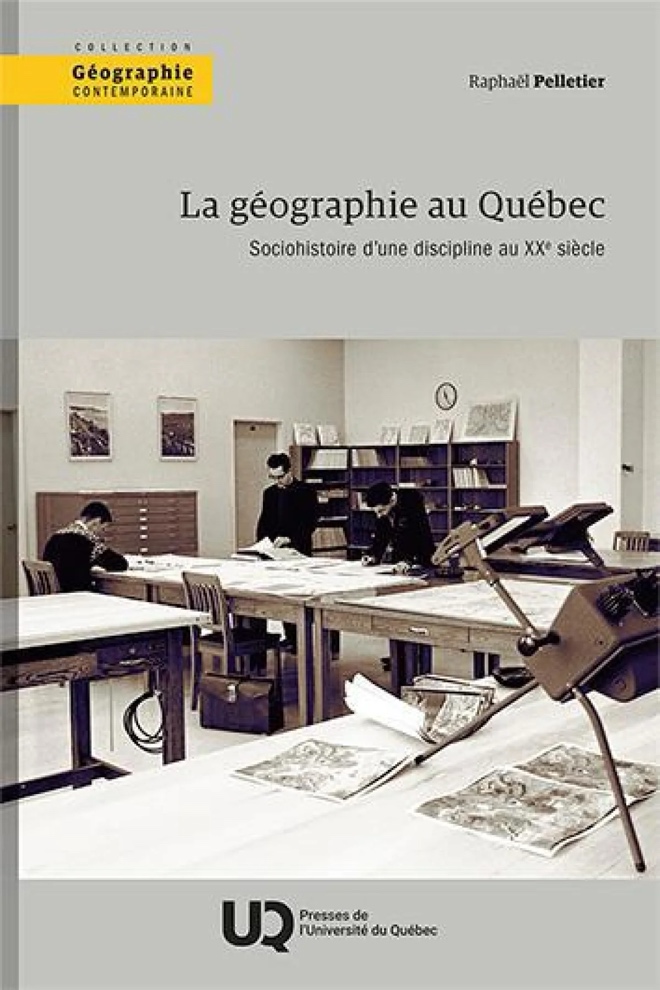
Also in this issue, in a nearly homonymic contribution, Raphaël Marquis-Pelletier interviews Raphaël Pelletier (Université TÉLUQ) about his book La géographie au Québec : Sociohistoire d’une discipline au XXe siècle (Presse U. de Québec, 2026), which explores the disciplinary formation of Geography in Quebec, including its interaction with the movement for Quebec independence.
We would like to thank Kevin Kaiser for his contributions to the Communiqué, and all the contributors to this issue!
This has been the first year of my term as CSHPS President, and I want to start by acknowledging the work of those who kept CSHPS going. Unlike larger academic societies, CSHPS is fully volunteer run, and I have been moved by the dedication of those who gave their time, expertise, and energy, sometimes amidst difficult personal circumstances.
First, I am deeply grateful to the officers of the Society. I thank our Past President, Tara Abraham, for her work as president in the last three years and for her support in navigating my new role this year. I am also indebted to the other officers, who were also new at their roles this past year: Andrew Inkpen, our Secretary-Treasurer; Ingo Brigandt, 1st Vice President; and Delia Gavrus, 2nd Vice President. I could not have worked with a better team. I am in awe of their dedication and their kindness.
I also thank those who contributed to the Society in different capacities: Communiqué editors, Advisory Board, the Website manager, the Local arrangements organizer, the Program Committee, the Nominating Committee, and the Hadden award Committee. Their work is essential. I hope they know that it does not go unappreciated.
For the organization of the 2026 annual meeting, some people deserve special thanks: Paul Bartha, Mélanie Frappier, Letitia Meynell, and Greg Scherkoske. Without them, it simply would not have been possible.
Lastly, on behalf of the society, I want to thank our host, Dalhousie University, and the University of Kings’ College as well.
Reflecting about the past year, I was going to say that it has been a busy and challenging year, but that is not new. I read the President’s reports of the last five years, and I realized that we have been confronting difficult challenges for a while: a pandemic, funding cuts to universities, and an increasingly difficult atmosphere for the humanities, besides worrisome political events. Past officers have been addressing how to improve CSHPS and what HPS members can do for some time. The work continues, and I hope to build on initiatives that previous Presidents put forward.
In 2022, the outgoing President, Alan Richardson, called our attention to the role of HPS in what he referred to as “the endless crush of alarming news in the world.” He noted that HPS perspectives are relevant to debates about climate change and surveillance technology, among others. Second, he noted the political attacks on the humanities and social sciences. He called on CSHPS to be “more active in the public sphere (Alan Richardson President Report, 2022). Since the news in 2026 continues to be alarming, I want to renew that call for us to take more active public roles in debates that will have an impact not only on academic matters but also on the welfare of people today and in the future.
In her work as President during the last three years, Tara Abraham also emphasized the need of “raising the profile of the society in the wider community” (Tara Abraham, President’s Report 2024).
I, and the other officers of the Society, also believe this should be a central goal during our tenure. When the value of the Humanities is under question, our Society needs to raise its voice to show that we have much to contribute. Some of the initiatives listed in the next section as objectives for the coming year aim to reach that objective.
Another major goal of past Presidents has been improving the interactions among members of the Society. As she noted in her outgoing President’s report, one of Tara Abraham’s goals was “to facilitate interaction between graduate students and faculty and to bolster graduate student representation in the society and plans for our meetings.” Tara worked tirelessly to achieve those goals and continues to do so. As another way to increase productive exchanges between the members, past Presidents also proposed organizing some online events outside the annual meeting, including mentoring events, special interest meetings, brain-storming sessions on HPS in the public life of Canada, etc. Unfortunately, until now, that has not proven feasible. But I will continue to explore ways in which we can foster both graduate student and faculty exchanges, and virtual interactions during the year.
Together with the current officers I will pursue several objectives this upcoming year.
Financial stability is key. We will need to enlarge the current budget for the Society to keep up with inflation, to have more funds for student travel support, and to pay for some tasks such as a social media coordinator.
To achieve this goal, we will have to increase membership dues soon. However, we can wait until we see what the conference fees will be for 2027. If they are high, we’ll keep the membership dues as they are for 2027. But this coming year, we will establish more categories with different dues levels. We will also have a period to renew one's membership, and the secretary will send 2-3 reminders.
We need to work on increasing our membership. To reach this goal, we encourage all members to talk to their colleagues about supporting CSHPS. Don’t underestimate the impact of personal involvement. Call upon your units to provide some support for students to join the Society.
Discuss in departmental meetings the need to support professional societies in the current climate of cuts in the humanities. Encourage your colleagues to become active in our society. If they are too busy to do so, encourage them at least to become members. The membership fee is low, and it is an easy way to support CSHPS.
The officers will continue to explore ways to attract more members, for example by offering group memberships and inviting more international members.
We would like to find better ways to increase diversity and inclusivity in our Society. We may organize a committee to focus on this. Anyone interested in volunteering, please, let us know.
We will work towards this goal in three ways:
One, we will continue the initiatives to encourage graduate student participation. We would like to have an active committee that helps us organize events. The mentoring pairings over lunch during the annual conference have been quite successful. We will continue to explore how to reach this goal.
Two, we will foster our connections with other associations, including forging links with various international organizations involving sciences and humanities. To this end, our first Vice-President, Ingo Brigandt, will become the IUHPST representative for Canada.
Three, we will try to organize one online workshop at the midpoint between our annual meetings. Given that the officers of the Society will be quite busy organizing the 2027 annual meeting, we are hoping that a member of the advisory committee or the graduate committee will volunteer for this task. Any member can also volunteer to organize some event for the whole community.
At the AGM, we will discuss what relationship we want to have with the Canadian Federation for the Humanities and Social Sciences / Fédération Canadienne des Sciences Humaines. Once we reach a consensus about whether we want to participate in Congress, we will be able to plan for our 2027 annual meeting.
As president, and on behalf of the officers of the Society, I encourage all members to become active in any capacity they can. We will work as a team to advance the mandate of the membership, but we also need the support and the participation of the members to achieve our goals.
In 2024, The Things They Carried: Unveiling the Place of Objects in the Global Circulation of Knowledge, an online international exhibit, was launched at the Maritime Museum in Kjipuktuk- Halifax (see Communiqué 107, pp. 18-20). The exhibit brings together digital objects that embody and exemplify the role of material objects in the global circulation of scientific knowledge. Presently, twenty-eight contributions from every hemisphere may be explored through a timeline, on a global map, or individually in the collections. From this collaborative work sprung a hands-on workshop at the recent CSHPS/SCHPS meeting in Halifax organized by Mélanie Frappier (Kings), Tricia Close-Koenig (U. de Strasbourg) and Gillian Gass (Dalhousie), and Dani Inkpen (Mount Allison). The session was built around two goals: sharing experience and expertise in teaching the history of science with objects, and promoting the next phase of The Things They Carried: an international conference to be held online with the Division of the History of Science and Technology (DHST) in the fall 2027.
The CSHPS session, titled “The Things They Carried/Ces choses transportées,” was held in a first-year teaching lab in the Dalhousie Life Sciences Centre. Approximately 20 attendees sat at hexagonal tables, upon which organizers had placed historical objects. After introductions from the chair, Mélanie Frappier, and a brief pitch for the 2027 conference from Dani Inkpen, Tricia Close-Koenig shared her knowledge of teaching with objects in the context of the history of science and medicine and then Gillian Gass presented lessons and insights from her many years of teaching a multiply-cross-listed course on marine science using historical objects.
Teaching with scientific artifacts can productively engage students more deeply with historical scientific practices and contexts, including social, political and economic questions related to craft, industry, actors and inequalities. Considering whose hands an object passed through and who contributed to markings of wear (and why) bring into view people other than the dominant researcher credited in publication. This approach is one means to effectively decentre or decolonize the history of science by forcing a shift in attention toward those histories that have been marginalized, underrepresented, or silenced.
Objects open up questions of use, discovery, and measurement. Yet, through them, other questions may also be glimpsed: questions of materials (Where were raw materials sourced? Who may have been exploited in natural source extraction? etc.), of mass production (is this object bespoke? Is it one of several, many, thousands, millions?), and of economic or political contexts. Not all of such questions are always readily accessed through archived documents. The markings and details of an object open doors to establishing critical and situated histories.
Moreover, teaching activities and assignments focused on artefacts and objects can detract from the crutch of generative AI use and the shortcomings it brings to learning, without shortchanging anyone in the process. Further, such courses lend well to cross-listing, which brings students from different programmes together, herein further enriching the course material as they exchange different knowledges and perspectives (e.g., Gillian brings life sciences and history of science students together; Tricia brings museum studies and history of science students together).
Associate the reading of Steven Shapin’s “Invisible Technician” article with having students, in groups of 2 or 3, examine laboratory objects. Have them list whose hands it might have passed through – from the sourcing of the raw materials to the current location – and the role they may have played in a research project and the recognition (or lack of) they received.
John Heningar-Shuh's “50 Ways to Look at a Big Mac Box” is a thought-provoking way to begin learning through objects. The list of 50 questions generates issues of materials and production, but also of logos and commercialisation, waste management and politics, etc. Such elements are often encountered with an everyday object but not often problematized. Begin with a well-known, contemporary object. This prompts questions about familiar markings, guiding students to question legislative, political, and social influences in decision making, production, and consequences. Continue with an historical object. This prompts—subsequently and rather naturally—similar political or economic questions about a scientific object, that a discussion of a publication or scientific theory might not prompt.
In the first class, have the class work in small groups (2 to 4) on the 50 questions with a Big Mac box, a Starbucks cup, or Tim Hortons cup.
In a second class, have the class work in small groups on the 50 questions, but this time with a historical scientific object.
In a third class, continuing to work on the same historical scientific object and the notes from the 50 questions. Have students establish a list of indications and ideas for learning more about the object: it’s production or manufacture, it’s use and circulation—including all markings (engravings, inventory numbers, etc.)—asking where and how can you find out more? Encourage students to expand beyond online sources, which may be sparse.
In a fourth and subsequent classes, have students prepare a report not only on the artefact they are studying, but the history and context it reveals. Invite them to problematize and criticize based on what they’ve learned through engaging the object. Propose multimedia options to present their research as an additional means to engage with materiality.
Additionally, include visits to laboratories, heritage sites, storage facilities, and exhibition spaces to see how scientific artefacts and objects are stored, provenanced, preserved, neglected and used—all of which are also part of the story of the artefacts.
The brief talks were followed by a hands-on, do-it-for-yourself, become-a-student-again session in which participants worked together with their “benchmates” to explore the scientific object that had been placed on their worktable. The objects included: a celestial globe from the early nineteenth century that had been rescued from a layer of chalkboard paint (applied so that it could be used to teach non-Euclidean geometry) and unearthed from a garbage bag in a closet of the Dalhousie physics department, an oceanographic apparatus for measuring current velocities, and a resonant tuning fork used in acoustical experiments, among other treasures.
Each group had copies of Shuh’s “50 ways to look at a Big Mac box,” supplemented with additional questions and guidelines to direct the examination of the objects. Participants learned firsthand how it feels to be a student confronting an unknown object. They were invited to consider it not as a token of discursive or bibliographic histories of science, but as a constitutive piece of the history of science. They were pushed to refocus their understanding of the history of science to see it as material practices and as the epistemically-generative circulation of objects through space and time.
The organizers’ three great hopes from this session are that it inspired people to bring material history techniques into their teaching, that it provided concrete ideas about why and how to do so, and that it generated excitement about the upcoming 2027 online conference. Supported by and co-organized with the DHST, this conference will connect scholars and practitioners from around the globe to develop international teaching, museum, and public engagement networks and tools centred on scientific collections and objects. The conference will ultimately expand the “The Things They Carried” digital exhibition (circex.ca) and lead to an online archive of teaching and researching resources. Until then, here follows a brief list. See you in fall 2027!
The Things They Carried: Unveiling the Place of Objects in the Global Circulation of Knowledge
Teaching with objects. This is an online platform created by the Erasmus+ research programme. The goal is to assemble and share sources and ideas on teaching with objects. The content concerns all levels of teaching.
Enquêtes d’objets. An example of the work prepared by 2nd year Masters students (both History of Science and Anthropology-Museology students) working in small groups on objects from the Université de Strasbourg collections.
Making clinical sense. This website was active during the ERC-funded research programme (PI Anna Harris) and it documents a variety of ways to research, think, and teach medical topics through materiality and sensory activities, not all of which concern medicine.
Fringe editions. This website, founded by Anna Harris following the Making Clinical Sense project, is an online publishing interface for makers, writers and other creatives working with medical education.
Madeleine Akrich. 2013. “La description des objets techniques,” dans Michel Callon et Bruno Latour (éd.), Sociologie de la traduction : Textes fondateurs. Presses des Mines, coll. “Sciences sociales,” 159-178.
Lorraine Daston, ed. 2000. Biographies of Scientific Objects. The University of Chicago Press.
Jill Decrop Ernst and Monica Zagallo. 2024. State of the Field, Teaching with Objects project research report: methods, tools, and possibilities of teaching and learning with objects, unpublished.
Cate Denial. 2024. A Pedagogy of Kindness. University of Oklahoma Press.
Anna Harris. 2020. A Sensory Education. Routledge.
Leonie Hannan and Sarah Longair. 2017. History Through Material Culture, Manchester University Press.
John Hennigar Shuh. 1982. “Teaching Yourself to Teach with Objects,” Journal of Education, 7(4), 8–15.
Max Leboiron, 2021. Pollution is Colonialism. Duke University Press.
Linda Tuhiwai Smith, 2021. Decolonizing Methodologies. Research and Indigenous Peoples, 3rd edition, Bloomsbury Collection.
Courtney E. Thompson and Kylie M. Smith, eds., 2025. Do Less Harm. Ethical Questions for Health Historians. Johns Hopkins University Press.
Susan Yee, “The Archive” in Sherry Turkle, ed., Evocative Objects: Things We Think With. The MIT Press, 31-35.
For almost three decades I have asked my philosophy of science students to leave the classroom and become temporary members of practicing scientific laboratories. Rather than observing science from the sidelines, they joined research groups as participants—sharing laboratory benches, seminars, coffee breaks, frustrations, and the occasional moment of discovery. The results have consistently surprised everyone involved. Year after year, the students produced some of the most original work in philosophy of science I have encountered -- work whose freshness and inventiveness often rivalled, and sometimes surpassed, much of the published literature.
The project began in the mid-1990s, shortly after I joined the University of King's College/Dalhousie University as the first outside professorial appointment in the newly established Contemporary Studies Programme (an innovative program built on the intersections of social and political thought, aesthetics, and philosophy of science). Many of my students arrived in my third-year philosophy of science core class with a familiar image of science: an impersonal institution governed by a universal "scientific method," objectivity, and fixed philosophical categories—or, conversely, as an institution to be critiqued from the perspective of “Critical Theory” and hermeneutics. Both approaches, it seemed to me, missed something essential: science as it is actually practised.
At the same time, science studies was being transformed by works such as Bruno Latour and Steve Woolgar's Laboratory Life and Ian Hacking's Representing and Intervening. They demonstrated that one learns something quite different by entering the laboratory itself. That suggested an obvious question: why not let philosophy students experience scientific practice firsthand?
Dalhousie, Canada's largest research-intensive university east of Montreal, provided the ideal setting. I approached laboratories across genetics, evolutionary biology, medicine, psychology, engineering, architecture, and materials science with what must have seemed a rather unusual proposal: would they accept two or three humanities students as temporary members of the research group for an entire term? Would they provide space in the lab for the students to do their coursework for other classes.
To my delight, they almost always said yes.
The students were not sent as ethnographers or observers standing quietly in the corner with notebooks. They became members of the laboratory community. They attended meetings, shared discussions, learned routines, watched experiments unfold, and, when appropriate, lent a hand. They entered not as apprentice scientists but as philosophers, carrying with them a grounding in all the “usual suspects”: Popper, Kuhn, Hacking, feminist philosophy of science, social constructivism, and related traditions. My only advice was simple: don't merely repeat what others have written about laboratories and science. Find your own questions.
They did.
Every year the laboratories generated investigations that neither I nor the researchers themselves could have anticipated. One group working in a molecular genetics laboratory became fascinated not with experiments but with architecture. Originally designed in the 1970s as an open, non-hierarchical space, the laboratory had gradually been remodelled with offices, walls, and physical barriers. By reconstructing successive architectural plans, the students showed how the changing physical space had quietly reshaped authority, collaboration, and even gender relations within the research group. The scientists were astonished to discover patterns in their own working environment that had become invisible through familiarity.
Another memorable study followed the installation of a sophisticated Zeiss mass spectrometer at the National Research Council. One technician had spent years in Germany working alongside its designers before returning to Canada with the instrument. The students realized that the expertise had travelled with the machine; in a very real sense, the technician had become part of the instrument itself – a true cyborg. Their project became a remarkable exploration of tacit knowledge, embodied expertise, and the mobility of scientific practice -- topics that continue to occupy philosophers and historians of science today.
There were many other adventures: students followed genes beyond the laboratory into industry and commerce, attempted (unsuccessfully – safety concerns!) to engage in the dismantling of Dalhousie's SLOWPOKE nuclear reactor, a group explored the history of obsolete scientific instruments hidden away in laboratory basements and the “nostalgia” experimentalists felt for those old analogue instruments, a group joined in on psychological research in which border collies themselves became active experimental participants -- true experimental “agents”, not objects. Mary Anne White, one of Canada’s leading chemists, took a group into her material studies laboratory to work with a large jerry-rigged machine that none of the graduate students knew how it worked or what it was for, but that it produced “great data”. Another went into the architecture lab where new building materials were being developed, informed by the fluid motions of modern dance. A lucky group had the pleasure of working with Canada’s leading microbiologist, Ford Doolittle, as he chopped down the received “tree of life” through lateral gene transfer. Every laboratory generated its own philosophical questions. No two years were ever alike.
The projects culminated each year in a public seminar within my philosophy of science course. Laboratory directors, graduate students, technicians, and researchers were invited back to hear the students present their work. Those discussions were often the most rewarding part of the entire enterprise. Scientists suddenly found themselves listening to philosophical analyses of their own everyday practices, while students defended their interpretations before the very people whose work they had spent months sharing. The conversations regularly continued long after the formal presentations had ended.
Perhaps the greatest surprise was that the learning never flowed in only one direction. The students certainly emerged with a richer understanding of science in action, one that bore little resemblance to the simplified accounts of scientific method found in most textbooks. But the laboratories also changed. Researchers began reflecting on assumptions, routines, language, and even the physical spaces in which they worked. Many later remarked that they had never before looked at their own scientific practice in quite that way.
Occasionally these encounters transformed lives and generated new scientific research trajectories. Cedric Blaise entered John Archibald's pioneering genomics laboratory as a student with a deep interest in history and philosophy of science. Immersion in cutting-edge genomics altered the course of his career, leading to a Gates Scholarship in HPS at Cambridge, and ultimately to research at the forefront of genomics itself. Many other collaborations also endured, growing into graduate supervision, research partnerships, conference collaborations, and friendships that have lasted decades.
Looking back, I have come to think that this was never simply an exercise in "active learning." It was an experiment in bringing philosophy and science into genuine conversation. The laboratories reminded all of us -- including me -- that scientific knowledge is built not only through theories and methods but through instruments, architecture, technicians, conversations, improvisation, practical judgement, and countless small acts of collaboration that rarely appear in philosophical accounts of science.
If philosophy of science hopes to understand science as it is actually practised, then sometimes it has to leave the seminar room and spend time at the coal face alongside those who produce scientific knowledge. Over twenty-five years I have watched that simple idea reshape not only generations of philosophy students but also the scientists and technicians generous enough to welcome them into their working lives. The boundary between the humanities and the sciences became, if only for a term, a little more permeable. In the process, many of our scientific collaborators became some of the strongest advocates for the importance of the humanities—not only within the university, but in the broader culture as well. That reciprocal transformation is perhaps the most enduring legacy of the project. I can think of no better example of active learning, and I would encourage colleagues across our discipline to try it themselves
In this essay, we’d like to encourage you to try adding a little more active learning in your teaching practice (however much you already do), and we’d like to convince you there are selfish reasons to do so.
The selfish reasons not to engage in active learning in your classroom abound: any change to your teaching involves effort; active learning can be harder to implement than some traditional teaching practices; outcomes can vary class to class; success requires buy-in from students; and (studies show) students don’t like active learning as much as passive lectures, and feel like they’ve learned less despite actually learning more (Deslauriers et al. 2019). The latter gives you an unselfish reasons to engage in active learning.
We contend that there are selfish reasons to include more active learning in your classroom: it is satisfying to see students learning, making connections in the classroom, and responding to feedback. When you can see students applying their knowledge, you can quickly gauge their learning and make small course corrections in your own plans.
Another selfish (self-interested) reason connects to evidence of your professional development as an instructor. At its most basic, using more active learning means you can talk about having done so, in annual evaluation reflections, teaching statements, reappointment/promotion dossiers, and wherever else you discuss your teaching. Active learning can also be beneficial because (indirectly, via engagement, or directly through their enhanced learning) it may translate to higher course evaluations or positive comments about the variety of course activities in your classroom; relatedly, it protects you from negative comments about long or dense lectures.
What is active learning? Rather than a single practice, it tends to be defined in opposition to more conventional lecturing, framed as a more passive experience for students. You may already be including active learning experiences within your classrooms without knowing it. Interest in active learning has accompanied enthusiasm for “flipping the classroom” where content delivery occurs between rather than during class sessions through assigned readings or recorded lectures – in this sense, humanities courses are often already flipped.
Our goal is to convince you to take a small step in the active direction. In our experience, one of the biggest challenges to making your class more active is imagining how to do so. Here are just a few examples to encourage you:
Finally, you can find inspiration in what colleagues have done. Isaac has contributed his “black box” exercise to a forthcoming STS Teachbook (York et al., forthcoming), a cookbook-style collection of teaching practices you can adopt. Brandt’s “lab study” entry is also worth a look. Teaching-focused blogs and disciplinary teaching journals are also great repositories of inspirational teaching ideas.
Whatever experiments you implement, we encourage you to be intentional about selecting or creating activities that fit your teaching context, respond to your students’ energy levels, connect to your learning goals for the course, and your time needs (in particular, build in transition time, time to explain the activity if it’s unfamiliar in your class, and any time for sharing out or reflection).
Beyond imagining what activities to incorporate is the challenge of what to remove to make space for active learning. In content-heavy classes, it can be hard to let go of precious readings, lecture notes, or fun performances by the instructor. We gently observe that if students are not learning this material, there is little point in keeping it. And stereotypes to the contrary, active learning does not undermine rigor. You can design engaging activities that give students the opportunity to apply course content to novel cases, progress through the stages of major assignments, and otherwise deploy what they’ve learned.
With practice, you may develop your more active classroom into one with more substantial experiential learning components (definitions vary, but at minimum include Kolb’s framing of direct experience plus reflection about that experience, leading to valuable meta-cognitive benefits). Many institutions are enthusiastic about experiential learning, especially given its connections to “real-world experience” and career readiness, and may have resources for instructors interested in developing such courses, from learning communities and book clubs to funding sources. Ellie’s recent co-authored handbook, Leading Experiential Learning on Campus (Heinrich et al., 2026) is focused on building and maintaining an institution’s experiential learning ecosystem and empowering faculty and leaders who support that work. But don’t be daunted; it’s easy to test the waters within your own course before committing to a major overhaul and decide what’s the best fit for your students, your career stage, and your own teaching goals.
We leave you with a final thought: incorporating more active learning requires a mental shift. We’ve argued that, despite the common attitude that it is hard for instructors to incorporate active learning into their teaching practice, through small steps you can build a more fulfilling, effective teaching practice for yourself through active learning.
En juin dernier s’est tenue la réunion annuelle 2026 de la SCHPS. En tant qu’étudiante à la maitrise, il s’agissait de ma première expérience d’un congrès en sciences humaines et sociales. À cette occasion, j’ai participé au programme de mentorat mis en place par la SCHPS afin d’obtenir un accompagnement personnalisé. J’ai beaucoup apprécié l’expérience.Elle m’a amenée à réfléchir au fait que les congrès présentent des caractéristiques qui en font un contexte particulièrement propice au mentorat.
Le mentorat occupe une place importante dans la formation et le développement professionnel des étudiant·e·s des cycles supérieurs. À travers la relation interpersonnelle d’accompagnement, la personne mentorée tend à développer davantage de satisfaction, de motivation et de compétence. Pour sa part, la personne qui agit comme mentor ressent une plus grande forme d’engagement vis-à-vis de sa profession ainsi qu’un sentiment de satisfaction. Une relation de mentorat appréciée par les deux partis repose sur l’authenticité et la réciprocité.
Plusieurs raisons justifient le recours au mentorat dans le contexte d’un congrès. La participation à des congrès est importante dans la transition vers l’identité professionnelle de chercheur. Or, il s’agit peut-être de l’un des contextes dans lesquels les normes implicites de la communauté scientifique sont le plus sentir. Les congrès mettent aussi en exergue un aspect curieux de la position de jeune chercheur·euse: la coexistence des rôles d’apprenant et de professionnel. À travers la pratique et l’exposition, l’individu doit acquérir de bonnes pratiques de recherche et intérioriser les normes de la communauté. Parallèlement, il doit se faire accepter dans un milieu professionnel. Le mentorat, particulièrement grâce au caractère interpersonnel qui lui est caractéristique, offre une avenue intéressante pour répondre à ces attentes.
Différents aspects propres au congrès en font un lieu de choix pour le mentorat.
Tout d’abord, les objectifs d’un congrès sont relativement bien définis. Avant l’évènement, la personne qui présente une communication doit préparer une présentation scientifique conforme aux attentes de la communauté. Pendant la conférence, la personne souhaite rencontrer des pairs, échanger des idées et de bonnes pratiques, obtenir de la rétroaction sur son travail, favoriser de futures collaborations. Alors que le ou la jeune chercheur·euse peut avoir du mal à identifier certaines règles non écrites quant au type de présentation demandé, au niveau de rigueur scientifique, etc., il tend à bien connaitre le but général d’un congrès scientifique. Ainsi, dans le cadre du mentorat, le fait que les individus aient des attentes claires et alignées avec celles du mentor favorise une bonne relation profitable.
De plus, un congrès est délimité dans le temps et l’espace. La relation de mentorat est donc moins engageante à long terme, mais peut découler en un engagement plus prolongé si souhaité. C’est donc un bon espace où expérimenter des types d’accompagnement, autant pour le mentor que pour le mentoré. Le grand bassin de participant·e·s est également non négligeable dans la mesure où le mentorat repose sur un bon arrimage d’intérêts, de valeurs, de qualités interpersonnelles, etc.
Enfin, le congrès est un lieu où les normes informelles de la communauté scientifique sont davantage explicitées que dans d’autres contextes. La relation interpersonnelle développée dans le cadre du mentorat crée un espace de suspension de certaines attentes, ce qui permet d’expérimenter avec les normes implicites de façon à les expliciter. Le mentorat permet de clarifier des attentes spécifiques dans un cadre bienveillant et constructif, par exemple relativement à la façon de présenter le travail ou à la langue à préférer. Il s’agit d’un endroit où tester les eaux.
Plus largement, le mentorat participe à l’intégration des futur·e·s chercheur·euse·s. Je suis bien consciente que, pour plusieurs mentors, cela représente une implication significative en termes de temps. Cela étant dit, même la simple relecture d’une présentation est appréciée. Notons aussi que la personne mentorée dont la langue seconde ou tierce est l’anglais peut bénéficier d’un mentor afin de s’assurer de la qualité de ses écrits préalablement à sa présentation. Ainsi, j’en profite pour remercier les personnes impliquées dans le programme de mentorat de la réunion annuelle 2026 de la SCHPS.
Our session, “Object Lessons,” at this year’s CSHPS conference came out of a particularly productive question Corey Orszak asked at The Canadian Association for Curriculum Studies a year ago. We were thrilled to see that it was joined this year by another session on education featuring Tara Abraham, Olivie Grenier, and James Elwick. The continuities between the two sessions led to a very productive discussion, not only among the panelists but also with the audience. This note briefly describes our three papers, in hopes of continuing the discussion and opening pathways to further collaboration. In our papers we considered the tensions inherent in learning with and through objects in the context of defined curricula or goals. We each sought to answer the question that Corey asked a year ago: “how can you avoid perverse understandings in student-led education” in the contexts of our own work: engineering training, educational research and development laboratories, and curriculum design and enactment in diverse settings/societies.
In “The Object as Discipline,” I argued two things. First, that curriculum, as we know it, largely serves to discipline education. We usually understand progress and knowledge by how well a student’s performance conforms to a set scope and sequence of study. Secondly, I argued that small steam engines were strongly agentic. Not only did they present catastrophic dangers if mishandled, when they were working well they provided “thick” feedback in the form of sounds, tactile sensations, smells, and visual cues. These characteristics allowed the object itself to take over the disciplining role of curriculum. Apprentices could be understood to have become engineers in their own right when they were able to produce results, regardless of the order in which they learned, or the scope of their skills and knowledge -- if the grain got threshed, the stone got crushed, and the logs got cut, the student had become an expert. Even if their methods and understanding were not the same as their mentor’s, they could make a strong claim to have avoided any significant problems or gaps in their understanding.
Ontario farm engineers chose to learn through informal networks of apprenticeship and self-study, and they preferred non-curricular approaches to engineering education over curricular ones offered by Mechanics’ Institutes and schools. Their approach was fundamentally object-centered, and they worked with relatively simple engines that substituted skill for mechanical complexity. In order to do a wide variety of different types of work under difficult and variable field conditions, they depended on extensive skillsets. As they applied one system of tools to many problems, they sought out new skills and deeper understanding. Using these methods, they successfully developed their skills and knowledge up to and beyond the level of contemporaneous academic experts, as those experts themselves reported. Their success demonstrates the potential of non-curricular approaches.
That their success depended on a central object with strong agency hints at the idea that applying similar approaches to other areas of study might require students to find ways to “listen” to “quieter” things—to allow those objects to exert a strong disciplining force—how to do that remains a topic for future work!
These kits modeled, in analog form, a potentially digital future for childhood education. They consisted of documentary bricolage, delivered to classrooms with minimal instructions for use, with the encouragement that the teacher "dump" the contents before their students, and leave the students to explore the supplied texts, images, and sounds in whatever way compelled them. Although, initially, built around a particular curricular imperative – to facilitate, in supplement to an educational television programme, interest in the history of the Great Depression – the form of each kit deliberately effaced a specific educational mandate. Their presumed virtue was the accumulation of latent information in different sensory and communicative forms, accessible in random order, and thereafter generative of unanticipated lessons and knowledge.
The kits modelled a potential future for computerized education predicated on mass, multi-modal, individualized information retrieval. They were thus, too, an argument for ongoing investment in computer science research at OISE related to developing, in theory and (eventually) practice, individualized computer-assisted instruction (CAI). The Media Group’s second kit, “The Perception Bag,” made the Group’s premise more explicit, in that its function was to encourage thought gleaned through spontaneous encounters with different sensory-provoking texts, objects, and (even!) scents. The educational future anticipated was one in which the computer displaced the authority of the teacher in the classroom. No teacher was required to guide use of the kit, nor evaluate a student’s work in relation to the kit. A second argument for computerized education was thereby embedded within this prototype: that investment in CAI promised a means for developing at scale alternatives to an educational practice – teachers – often assumed in Ontario in the 1960s to be outmoded in their methods, undertrained in their ideas, and antithetical to educational progress and change.
But in attempting to model a future for CAI in Ontario the kits ran into a problem: what, if anything, did a child learn making use of the Perception Bag? And at what cost to the school boards potentially making use of such kits in the future? Or, indeed, what cost to OISE itself, which struggled in the 1970s to justify its expenditures and unique status as an independent college and educational research and development laboratory before a diversity of Ontario’s educative publics? The practical curricular object the Institute had produced belied its complementary function as a working theory for the best use of educational resources in the Province. That theory was not, in whole, accepted by the politicians and civil servants tasked with picking among a number of competing educational theories, although the incentive of reduced labour costs in education through increased delegation of teaching tasks to “the computer” has hardly abated since the 1960s.
I use the idea of the curricular object [see Figure 1] to highlight this tension between agency, object, and curriculum. In this talk, I explored different techniques that might shape encounters of objects and curriculum for the learner. Objects, I argue, can be selected to soften, sharpen or attain a curricular goal. I also explored how one might control an object through the curriculum while maintaining learner agency.
The first example I considered was the following curricular expectation from the Ontario grade 2 Social Studies curriculum:
A1.4 identify some ways in which First Nations, Métis, and/or Inuit individuals, communities, and nations are reclaiming traditions, customs, teachings, and celebrations that were banned, lost, or practised in secret due to settlement and/or colonization, including the residential school system (Emphasis added)
The apparent given object is Residential school history. However, the overall expectation (why traditions change), the pedagogical questions, and the age of the students specified in the curriculum document suggest that this is not an ideal object. Instead, we might choose objects that are focused primarily in the present context and on reclamation itself, yet don't ignore residential schools. I disciplined the curriculum to better reflect the overall strand “Changing Family and Community Traditions” by selecting different objects: a documentary film about a Wolastoqey immersion school run by a Residential school survivor, a clip of Jeremy Dutcher receiving a Polaris award for his Wolastoqey music album, and a TVO special for children about Pow Wows. These objects highlight indigenous resilience and resurgence directly. This is an example of disciplining curriculum through object selection.
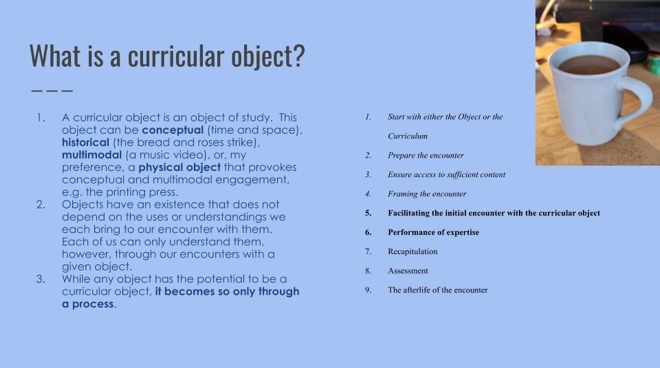
The second example I used was the Haggadah, an explicit pedagogical manual for teaching culturally important aspects of the Exodus story. In this case, the object (Exodus) is disciplined through three pedagogical techniques: parable, catechism, and guiding questions. The parable of the four sons lays out different student attitudes and appropriate teacher responses; the catechism of the Four Questions lays out key understandings; and the inquiry guidelines are set through commentary, readings, and additional guiding questions. The Haggadah also uses the curricular strategy of grouping in including specific psalms and blessings correlated to certain moments in the story. The deliberate use of selection, grouping, parable and catechism are protective against perverse understandings within the communities they are produced by/for.
We attempted to understand objects and discipline as they relate to knowledge acquisition. As objects, agricultural steam engines could replace curriculum in the role of disciplining force. In a political climate that distrusted and sidelined teachers, there was something intriguing in “Boxes” that cast off disciplining factors and reimagined curriculum as an unstructured assortment of objects to be assembled into a coherent understanding by the student. In the context of the Ontario curriculum and the Haggadah, perverse understandings can be mitigated through a judicious blending of curricular constraint, pedagogical strategy, and object selection. In each case, there remains some danger of mishaps, detours, and perverse understandings, both in student outcomes and instructor use. It also seems dangerous, however, to downplay the object and with it the agency of the student and the critical and applied thinking that motivates learning and innovation for many people.
When I started teaching at Virginia Commonwealth University in Qatar in 2013, coming across many spelling and grammar mistakes in a student essay would frustrate me. Why did the student not read their work carefully or use the proofing tool of their word processor? Over a decade later, encountering orthographic and stylistic idiosyncrasies tends to put a smile on my face. At least, the learner tried to use their own linguistic knowledge instead of generating text on the basis of large language models. However flawed the arrangement of letters on the page may be, I can hear the student’s own voice rather than that of their chat bot.
Unfortunately, the essays with strange words and sentences I receive get fewer and fewer. As more and more of my students have come to rely on ChatGPT and similar applications for their take-home papers, stylistic diversity has also shrunk. When differentiating between submissions for the purposes of grading, I can also depend less on variation in orthography, syntax or even overall structure. Texts by weaker and stronger students increasingly look and sound similar and often appear as bland and boring as the statistical models on which they draw. When did an AI tool last generate an essay that was truly radical or offensive to you? In order to convince me that their work is worth an A or B, students have always needed to demonstrate original thought. However, to help me distinguish their own ideas from those of others, I now ask them to be more thorough and broader in their referencing and acknowledgements.
Back in 2013, when going through my students’ bibliographies, I was mainly looking for the presence of monographs and journal articles and for consistency in following one style guide or another. As large language models often hallucinate, I am now spending more time verifying whether the sources in the footnotes actually exist. Moreover, I increasingly value a diversity of references beyond the traditional formats of scholarly literature. If the students use generative AI tools or any other computer programs, I ask them to declare it, not just for the sake of transparency, but also as a way of giving credit to software developers. The same goes for websites and datasets. Linking to the YouTube videos, social media posts and Wikipedia pages they use not only helps me understand their research process more fully, but also acknowledges the contributions of content creators and editors who may not hold academic positions. If your friend, relative or acquaintance helped you with your assignment, please say so and mention their specific expertise.
Getting students to refer to a very broad range of sources often requires more classroom conversations and feedback on scholarly apparatuses. In the past, I would have simply recommended that my students create consistent lists of books and articles in accordance with the Chicago Manual of Style or the MLA Handbook. Nowadays, I dedicate more time to explaining the importance of including versions and licenses in software citations, for example. I would encourage students to include an acknowledgements section not just in theses and dissertations, but also in shorter papers. Even if the only people thanked in it are employees of our university (such as librarians, archivists or writing center staff), knowing their names helps me understand which resources my students have consulted and which they may have overlooked.
Striving for comprehensive critical apparatuses might not only help students earn better grades and avoid potential accusations of plagiarism; it would also support students in publishing their work. Outside of the classroom, as a journal editor and reviewer, I increasingly scrutinize submissions for AI-generated content. The quicker an author convinces me that their work is done by a human brain, for instance by showing their networks with other people, the more enthusiastic I am to be their mentor. The better overview I have of all the sources they have consulted (digital or otherwise), the more I can appreciate the work undertaken and the better suggestions I can make for improving a manuscript. This lesson from editorial work, I would like to share with students early on.
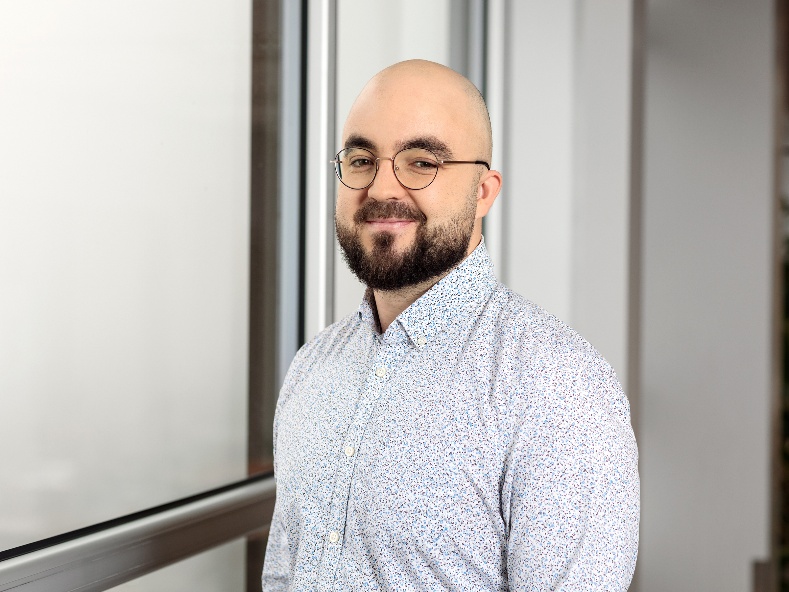
Entretien avec Raphaël Pelletier, auteur du livre « La géographie au Québec: sociohistoire d’une discipline au XXesiècle », publier par Presses de l'Université du Québec en 2026.
R. Marquis-Pelletier: Merci d’avoir accepté de répondre à nos questions. Pour débuter, pourriez-vous nous parler des origines du projet de thèse qui est devenu ce livre ?
R. Pelletier: En consultant ce qui avait été écrit sur l’histoire de la géographie au Québec, je me suis aperçu que le sujet avait été essentiellement traité par des géographes eux-mêmes, et très peu par des historiens, des sociologues ou des philosophes. L’histoire de la discipline était souvent abordée à partir de questions comme: qu’est-ce que la pensée géographique ? Est-ce qu’il y a une pensée géographique sous-jacente à la géographie qui est pratiquée au Québec ? À mon sens, il manquait une réflexion sur la manière dont cette géographie se pratique et se vit dans les institutions. Cela m’a poussé à adopter un cadre plus sociologique, ou socio-historique, d’où le sous-titre du livre, « Sociohistoire d’une discipline au XXesiècle », qui reflète bien l’approche que je me suis donnée: celle d’une histoire sociale de la discipline.
Quel cadre théorique avez-vous adopté pour procéder à cette analyse ?
Avant même de commencer mon doctorat à l’UQAM, j’avais en tête de mobiliser la théorie des champs et la sociologie des sciences de Pierre Bourdieu. Mon directeur de thèse, Yves Gingras, avait travaillé à formaliser la théorie des champs développée par Bourdieu, mais d’un point de vue historique, c’est-à-dire en cherchant à historiciser l’émergence des champs disciplinaires, ou du champ scientifique de manière générale. Il a ainsi contribué à développer le modèle de la disciplinarisation, que j’ai adopté comme levier interprétatif dans la thèse.
Pour résumer rapidement, la disciplinarisation repose sur l’idée qu’il existe des invariants sociologiques permettant d’interpréter comment une discipline émerge et s’intègre dans un environnement social. D’abord, il faut qu’il y ait émergence de pratiques nouvelles, qui s’intègrent ensuite dans un environnement institutionnel préexistant; les pratiques de recherche en géographie émergent et prennent place dans un environnement social qui existe déjà, et doivent répondre à certains impératifs institutionnels. Ensuite, il y a consolidation et construction d’une identité disciplinaire: les acteurs qui s’investissent dans ces pratiques et ces institutions finissent par se réclamer de leur appartenance à celles-ci.
C’est entre autres à partir de ces trois invariants que j’ai cherché structurer l’ouvrage. Je me suis d’abord intéressé à l’inscription de la géographie dans l’enseignement supérieur, puis à la façon dont celle-ci a donné forme à des collectifs disciplinaires. Finalement, j’ai étudié comment la discipline vit et prend forme lorsqu’on sort du champ scientifique, notamment au travers de la question de l’intégration des diplômés de géographie sur le marché du travail, ce qui m’a amené à traiter de la question sous l’angle de la sociologie des professions.
Une des tensions abordées dans le livre est celle du débat entre une conception unifiée ou généraliste de la géographie et la spécialisation. Comment expliquez-vous la spécialisation croissante de la géographie à partir des années d’après-guerre ?
Ce que je trouve intéressant dans ce cas-ci, c’est qu’on observe l’illustration d’un processus qui, bien qu’ancré dans un champ défini, la géographie, n’est pas spécifique à ce champ. Presque toutes les disciplines connaissent, à partir des années d’après-guerre, des vagues de spécialisation, particulièrement intenses en sciences naturelles entre les années1950 à 1970. La géographie ne fait pas exception: les pratiques de recherche et les conditions de financement intègrent des incitatifs à la spécialisation, renforcés par l’importance croissante de la publication comme unité de mesure de l’excellence et comme levier d’avancement de carrière. La géographie n’est donc pas exceptionnelle sur ce plan, mais la forme que prend le phénomène est conditionnée des spécificités disciplinaires.
Le livre fait état des débats récurrents sur la place des départements de géographie dans les institutions. Qu’est-ce qui fait en sorte qu’à certains moments de l’histoire, on ait été amené à réfléchir à la localisation de la géographie dans les institutions ?
Au Québec, les universités francophones ont longtemps suivi l’exemple français. Autrement dit, on a associé la géographie à l’histoire. La géographie, la « petite sœur » de l’histoire, était donc placée dans les facultés de lettres. Dans le livre, je soutiens l’hypothèse que la géographie a bénéficié, malgré la spécialisation des pratiques et la scission de plus en plus claire entre la géographie physique et la géographie humaine, d’une forme d’inertie institutionnelle. Par défaut, la géographie devait être au côté de l’histoire, et donc on n’avait pas vraiment à se poser la question de la place de la discipline. Périodiquement, les géographes se sont eux-mêmes demandé s’ils devaient être du côté des sciences naturelles ou des sciences sociales, mais il a fallu des débats administratifs, souvent externes, pour forcer une prise de position.
Le cas de l’Université Laval est assez emblématique à cet égard, et ce, dès les années 1960. Toutefois, à partir des années1990, des impératifs de rationalisation des ressources administratives et une volonté de rééquilibrage entre les facultés vont mener à la fin de cette inertie institutionnelle. La géographie devient une candidate idéale pour ce type d’opération. Où doit aller la géographie ? Du côté des sciences naturelles ? Du côté des sciences sociales ? Est-ce qu’on crée une nouvelle faculté qui permettrait de joindre, par exemple, l’aménagement, l’urbanisme, l’architecture et la géographie ? Ou est-ce que, finalement, on fait éclater le département et les professeurs sont répartis ailleurs dans l’université ? Il y a eu une forte levée de boucliers, car on craignait que les géographes s’acculturent à leurs milieux d’accueil et qu’ils cessent de faire vivre la géographie. En fin de compte, on a maintenu l’unité de la géographie dans une solution de compromis. À partir des années2000, la géographie est rattachée aux domaines de la foresterie et de la géodésie, donnant forme, en 2001, à la Faculté de foresterie, géographie et géomatique.
Vous mentionnez que l’association entre la géographie et l’histoire dans les facultés québécoises s’explique par l’influence de la tradition française. Comment le développement des départements québécois diffère-t-il de celui des autres départements d’Amérique du Nord?
Les gens qui animent les premières heures de la géographie au Québec, entre les années1920 et 1940, sont formés en France. De retour ici, ils reproduisent le modèle, ayant intégré un habitus français. Or, même en France, il n’existait pas d’agrégation de géographie avant 1943-1944. Il s’agissait plutôt d’une agrégation d’histoire-géographie. Les premiers grands noms de la géographie française étaient donc également historiens de formation. En France, la géographie s’était organiquement développée aux côtés de l’histoire du fait d’historiens, et cette organisation s’est en quelque sorte transposée au Québec.
Aux États-Unis et dans le Canada anglais, le développement s’articule différemment. On observe certains cas où les départements de géographie se sont plutôt développés conjointement avec ceux d’économie. À l’Université de Pennsylvanie, par exemple, la discipline se développe au sein de la Wharton School, une école destinée aux économistes et aux gens d’affaires. Cependant, de manière générale, et bien qu’il existe des exceptions comme le cas de l’Université de Toronto, la géographie va d’abord prendre place du côté des sciences naturelles, principalement par le biais de la géologie. À Harvard, avant la fermeture progressive du programme puis du département à la fin des années1940, la géologie et la géographie étaient réunies en un seul et même département. Il en fut de même à l’Université de la Colombie-Britannique à partir de 1922. Dans tous les cas, la tradition anglo-saxonne tend à associer la discipline à d’autres domaines scientifiques.
Vous consacrez un chapitre complet, un « intermède », à Louis-Edmond Hamelin. Pourquoi avez-vous voulu traiter de sa trajectoire en particulier ?
D’abord, Louis-Edmond Hamelin est une figure emblématique de la géographie au Québec. Il assiste aux premières heures de la formation en géographie, puis part en Europe pour se former auprès de Raoul Blanchard à Grenoble. Il a vécu durant toute la deuxième moitié du XXesiècle, donc, seulement sur le plan chronologique, c’est un témoin assez privilégié de l’évolution de la discipline. Ensuite, c’est quelqu’un qui a beaucoup écrit sur sa propre trajectoire: il a plusieurs autobiographies et des livres d’entretiens. Il existait donc déjà une matière publiée pléthorique, à laquelle s’ajoute un immense fonds d’archives conservé à l’Université Laval: le répertoire, à lui seul, fait plus de 100pages.
Le cas d’Hamelin est intéressant, car il est à la fois absolument central dans le champ, donc exceptionnel, mais aussi vraiment typique de la trajectoire des géographes de sa génération. Il part en Europe, est formé là-bas et revient, puis décide de mettre l’épaule à la roue et de contribuer à l’effort d’institutionnalisation de la géographie au Québec. Mais c’est aussi quelqu’un qui s’inscrit dans les mêmes débats que ses confrères et consœurs. C’est aussi un personnage singulier et attachant. C’est quelqu’un dont le père était agriculteur, qui décide de faire de « grosses études », comme il le dit lui-même. Et puis, il était un peu hors lieu, c’est-à-dire que sa trajectoire en est une de bifurcation. Compte tenu de son milieu d’origine, sa vie aurait pu être toute autre!
Quel élément de vos recherches vous a surpris ?
Paradoxalement — ça aurait dû être une évidence —, je n’avais pas prévu de voir émerger la question des débats sur l’indépendance du Québec de manière aussi forte. J’ai fini par consacrer une bonne portion du second chapitre sur les manières dont cette question, au début des années1960, a fini par devenir une ligne de faille entre les géographes eux-mêmes, puis a déterminé les formes de sociabilité disciplinaire. Adhérer ou non au projet déterminait également, d’une certaine façon, sa position dans le champ de la géographie au Québec. Je ne m’y attendais pas, alors que c’est un épisode absolument charnière de l’histoire du Québec contemporain. D’une façon plus générale, j’ai mené ce projet pour étudier la géographie, mais cela m’a amené à réaliser qu’étudier la géographie au Québec, sa pratique, ses lieux et son institutionnalisation, permet de mieux comprendre l’histoire du Québec, et que, inversement, le fait d’étudier le Québec contemporain conduit à une meilleure compréhension de l’histoire de la discipline.
Mark Solovey, University of Toronto Institute for the History and Philosophy of Science and Technology, has been developing new courses in line with his evolving interests and a growing awareness about unmet needs and hence significant opportunities in HPS education at the undergraduate and graduate levels . For undergraduates, he developed a new course called Vegetarianism and Veganism: Science, Technology, Human Health, Animal Welfare, and the Environment, which he has taught three times, each with very high levels of student engagement. This seems important to note because there is no other course at any Canadian university that provides students with a broad introduction to the history and contemporary contexts of veg*ism - and it seems that there is only one such course at any US university (UC-Santa Barbara). In Mark's course, offered through the HPS program, students engage extensively with scientific, technological, and health aspects of veg*ism as well as major intersecting issues. Here's a bit from the course description: "What is vegetarianism? What is veganism? Are these cultural fads, lifestyle choices, moral imperatives, socio-cultural movements, religious commandments, commercial enterprises, all of the above, or something else? This course examines the past, present, and future of vegetarianism and veganism, with a focus on five central themes: science, technology, human health, animal welfare, and the environment. Along the way, we will consider many other important issues and contexts, including: factory farming, capitalism, social identities and inequalities associated with gender, race, and class, religious beliefs and practices, high-performance sports, and cultural resources such as documentary films, television programs and music videos." At the graduate level, Mark is developing a new seminar called Science, Animals, and Values, which he will teach for the first time this fall. From the course description: "This seminar examines the nexus connecting science, animals, and values in historical and recent contexts. To do this, we will explore how developments in science, technology, and medicine have reflected and shaped our views about the value and nature of non-human animals — i.e., their lives, histories, needs, mental capacities, habitats, and environments. We will examine how scientifically inflected understandings of non-human animals have been intimately connected to understandings of human beings as well as important social differences, for example at the levels of race, class, and gender. We will also consider how science has illuminated the profound impact of human activities on non-human animals in ways that have provoked deep concern. Course materials and activities will challenge students to understand and think critically about scholarly works in this area that come from many different specialties, such as animal studies, environmental studies, history, legal studies, philosophy, political economy, science and technology studies, as well as from the histories of science, technology, and medicine. This seminar is an excellent fit with our unit's distinctive interdisciplinary character and the interdisciplinary interests of many of our graduate students." If anybody is interested in seeing the full syllabus for either course, let Mark know. Related to those endeavors, Mark has recently received support for a new Jackman Humanities Institute Working Group on the topic Animals, Science, Law, and History: Canadian and Global Contexts. The group, which he organized and which consists of faculty, graduate students, undergraduate students, and community members, will meet once a month starting in September.
A new Institute for the History of Science has just opened. It is part of Medeniyet University in Istanbul and occupies two of the eight madrasas of the Semaniye complex (founded by Sultan Mehmet II), located adjacent to the Fatih Mosque. The Institute’s remit is the global history of science, but with an especial emphasis on the history of science in the Islamic world.
For 2026-2027, the Institute will offer MA and PhD programs in Turkish, and an MA program in English. Applications can be submitted between 17 and 24 August 2026.
Please note that non-Turkish applicants for the English MA are exempt from the ALES requirement. Students who have graduated with a BA from an English-language institution are also exempt from the foreign language (English) requirement.
The Institute is organizing a symposium devoted to the life and works of Taqī al-Dīn al-Rāṣid, as well as to the larger intellectual context of the sixteenth-century Mediterranean. It will be held 2-4 December 2026 in Istanbul. More information and the call for papers can be found online.
June 6, 2026, 11:45am – 1:45pm, Location: Alumni Hall, University of King’s College, Halifax.
In attendance: Drew Inkpen, Marga Vicedo, Letitia Meynell, Andrew Reynolds, Jamie Elwick, Elizabeth Newwald, Vincent Guillin, Molly Kao, Aude Bandini, Oliver Grenier, Vincent Auffrey, Raphaël Marquis-Pelletier, Cassandra Williams, Hongyu Chen, Clarisse Paron, Delia Gavrus, Reid Fraser, Isaac Beliveau, Marianne Lapierre, Ashai Khan, Ingo Brigandt, Polly Winsor, Gordon McNickle, Lily Wu, Corey Orszak, Mike Roberts, Matthew McLauglin, Andrew Jones, Austin Due, Jessica Casey, Alexandra Calzavara, Nayani Jensen, Michael Kishchuk, Paul Bartha, Ernie Hamm, Farid Saberi, Sara Varón Echeverri, Adam Koberinski, Catherine Stinson, Kenton Kroker, Rida Jafar, Veronique Gillier, Dani Inkpen, Mélanie Frappier, Aaron Wright, Antoine C. Dussault, Allan Olley, Tara Abraham, Megan Krempa, Mark Solovey, Vivien Hamilton, Alexei Kojevnikov, Fiona Li, Michael Travisano, Sydney Doering, Ken Waters, Stephen Snobelen, Ian Stewart, Tricia Close-Koenig, Hyung Wook Park, Rosie Pryce-Digby, Aniqa Jalal, Gordon McOuat, Aaron Prosper, Jacob ’tMannetje, Fabien Cayer, Tyler Delmore, Erik Nelson, Yanick Laverdière (online), Hasan Umut (online).
The 2026 CSHPS meeting in Kjipuktuk/Halifax featured 90 presentations across 30 sessions, drawn from 103 individual submissions and 8 panels. More than half of submissions were from students. Program was highly competitive.
In the absence of the Congress for the Humanities and Social Sciences, CSHPS collaborated with the following six others societies to create a mini-congress [CSHPM (Canadian Society for the History and Philosophy of Mathematics, meeting 4-6 June), CPA (Canadian Philosophical Association), CSA (Canadian Society for Aesthetics, meeting 7-8 June), CJMA-ACJM (Canadian Jacques Maritain Association), CS-IVR (Canadian Section of the International Association for Philosophy of Law and Social Philosophy), CSCP-SCPC (Canadian Society of Christian Philosophers), CSSPE (Canadian Society for the Study of Practical Ethics)
Lesley Cormack has held this position for ~20 years, but would like someone else to serve role. Suggestion is to make this a duty of the 1st VP of the Society (duties include: delegating at least one member to attend IUHPST AGMs and report back; fill out yearly report for the National Research Council, which used to be the job of the Secretary-Treasurer).
Conversation ended with a straw poll:
Above discussion took us to the end of the annual general meeting.
We were rushed from the room and the meeting ended without a motion.
Communiqué relies on and welcomes your updates and contributions!
Email the editors at cshps.communique@gmail.com